AI in Unreal Engine vs Unity - LLM Integration Comparison
Both Unreal Engine and Unity can integrate AI models, but the approaches, ecosystems, and available tools differ significantly. If you're choosing an engine for an AI-heavy game, here's what matters.
Unreal Engine Advantages for AI
- Blueprint visual scripting. Designers can wire up AI interactions without writing code. Async Blueprint nodes make complex AI pipelines accessible.
- C++ performance. When you need maximum control, C++ APIs give direct access to AI functionality with compile-time safety.
- Mature plugin ecosystem. Purpose-built AI plugins like GenAI for Unreal cover every major AI provider with production-ready implementations.
- Visual quality. AI-generated 3D models and textures look best in Unreal's rendering pipeline. Nanite and Lumen handle AI-generated geometry and materials beautifully.
- Fab marketplace. Unreal's marketplace has dedicated AI plugins that are reviewed, maintained, and supported.
What's Available for Unreal Engine
The AI plugin ecosystem for Unreal covers:
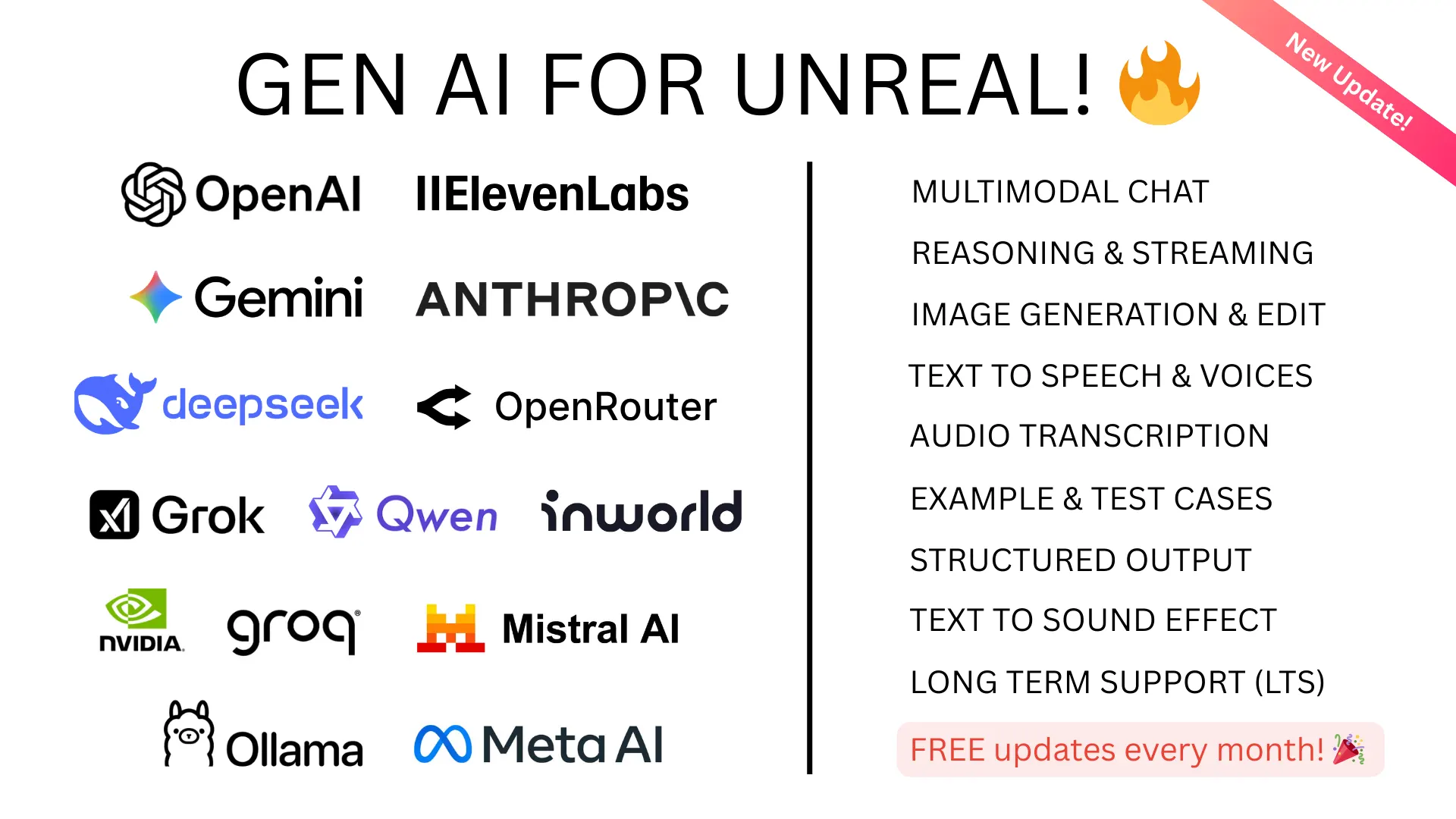
- 6+ chat providers: OpenAI, Anthropic, Google, XAI, DeepSeek, and OpenAI-compatible endpoints (Groq, OpenRouter, Ollama, Mistral)
- Image generation: DALL-E, GPT-Image-1, Imagen 4.0
- Voice AI: OpenAI TTS, ElevenLabs, Google TTS, Whisper, Realtime API, Gemini Live
- 3D generation: Meshy, Tripo AI, Hyper3D Rodin, fal.ai, Google textures
- Local AI: Ollama integration for offline LLMs (Llama, Mistral, Phi, Gemma)
- Chinese market: Alibaba Qwen, Bytedance, Moonshot AI
Our Plugin Suite
- GenAI for Unreal — comprehensive cloud AI plugin
- GenAI Model Generator — AI 3D model and texture generation
- GenAI Llama — local AI with 7 providers + embedded inference
- GenAI Chinese Models — Chinese AI providers