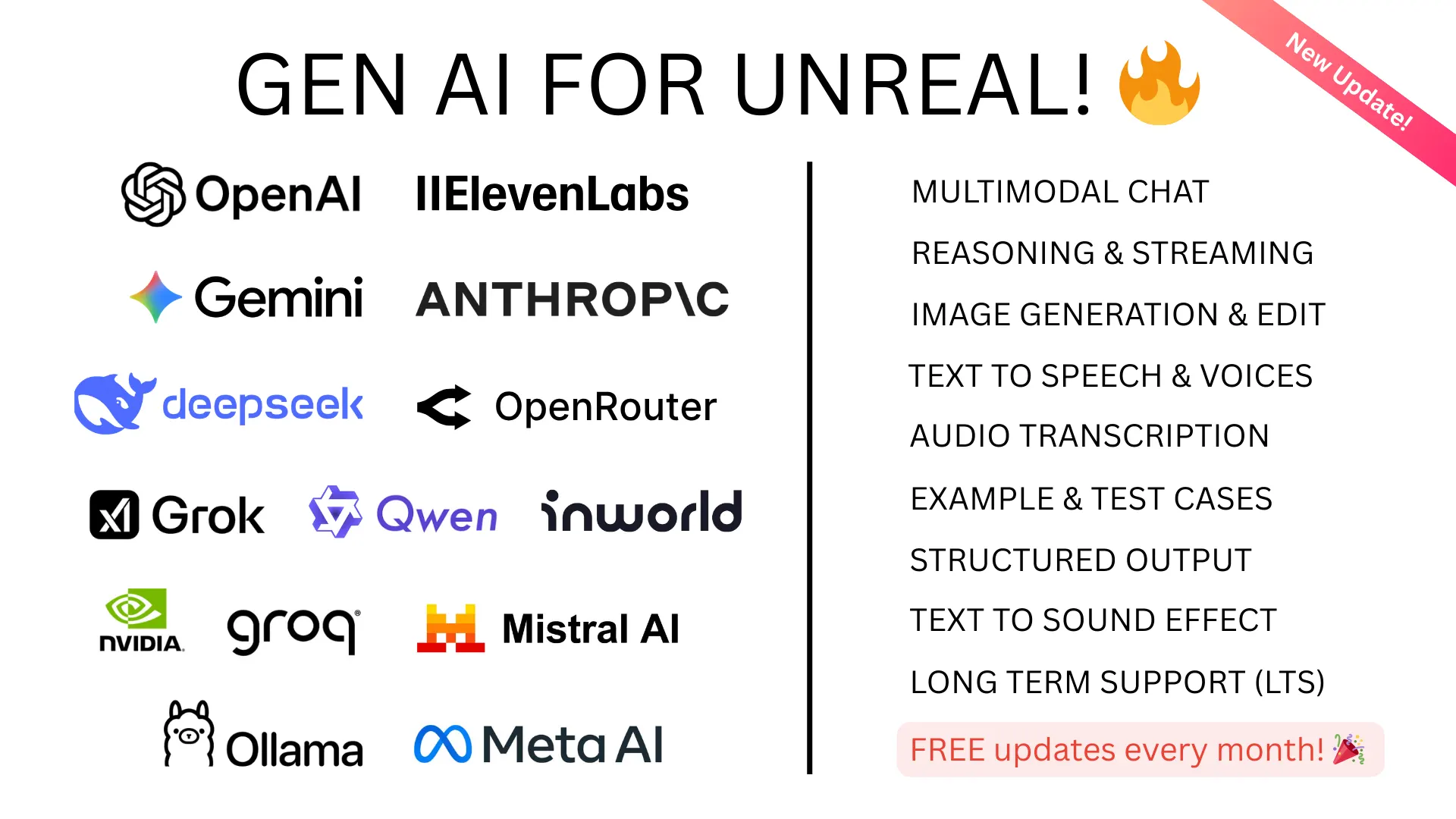
Local AI vs. Cloud AI for Game Development
When integrating Generative AI into your Unreal Engine 5 project, the first major architectural decision you face is whether to run your models in the cloud (via APIs like OpenAI or Anthropic) or locally on the player's machine (via Llama.cpp or Ollama).
Both approaches have severe trade-offs regarding cost, privacy, capability, and hardware constraints. This guide breaks down the reality of shipping AI in 2026.
Cloud AI (ChatGPT, Claude, Gemini, DeepSeek)
Cloud AI involves sending player input to a remote server, generating the response on massive enterprise GPU clusters, and streaming the data back to the game client.
Pros of Cloud AI
- Maximum Intelligence: Models like GPT-5 and Claude Opus possess reasoning capabilities, world knowledge, and instruction-following that local models cannot match.
- Zero Hardware Cost for Players: The player's GPU/CPU isn't utilized for AI inference. The game can run on a potato, as long as it has internet access.
- Ecosystem Access: Cloud providers offer unified ecosystems—you can get best-in-class text, Text-to-Speech (TTS), and Image Generation from a single API.
Cons of Cloud AI
- Always Online: The game cannot be played offline. API outages mean broken game features.
- Ongoing Costs: You (the developer) pay per token. If a player sinks 100 hours into talking to NPCs, your cloud bill scales linearly. You must build robust proxy servers and rate-limiters to prevent abuse.
- Latency: Even with streaming, network round-trips add latency, which can break the immersion of real-time voice interactions.
Local AI (Llama 3, Mistral, Gemma, Phi-3)
Local AI involves bundling an open-source model weights file (usually a .gguf) directly with your game files, and running the inference directly on the player's GPU or CPU.
Pros of Local AI
- Zero API Costs: Inference is free. A player can play for a thousand hours and it costs you nothing in server bills.
- Offline & Private: No internet required. Player data and chat logs never leave their machine, satisfying strict privacy requirements.
- Uncensored/Customizable: You can fine-tune open-source models specifically for your game's lore without dealing with a provider's safety filters arbitrarily blocking combat dialogue.
Cons of Local AI
- Hardware Constraints (VRAM): The model must fit in the player's VRAM. A 8B parameter model requires ~6GB-8GB of VRAM. You cannot ship a 70B parameter model to an average consumer.
- Performance Impact: Running inference steals GPU cycles away from rendering your game. Your framerate will drop when the AI is generating text.
- Lower Capability: Small models (1B to 8B parameters) suffer from hallucinations and struggle with complex logic compared to frontier cloud models.
The Solution: The Hybrid Architecture
The most successful AI-driven games use a Hybrid Architecture.
Using our GenAI for Unreal and GenAI Llama plugins, you can implement dynamic fallback logic:
- Primary (Cloud): If the player has internet access and your server quota is healthy, use gpt-5.1 for complex story quests and deep NPC conversations.
- Secondary (Local): For ambient NPC "barks," generic shopkeeper dialogue, or if the player goes offline, dynamically route the requests to an embedded Llama.cpp model running on their machine.
By treating Cloud AI as an "enhancement" rather than a strict requirement, you protect your server costs and guarantee the game remains playable forever, long after servers are shut down.